Will Ordinary People Be Replaced by AI?
At 2 a.m., you scroll and see a news story: “XX Company cuts 3,000 jobs; AI replaces human work.”
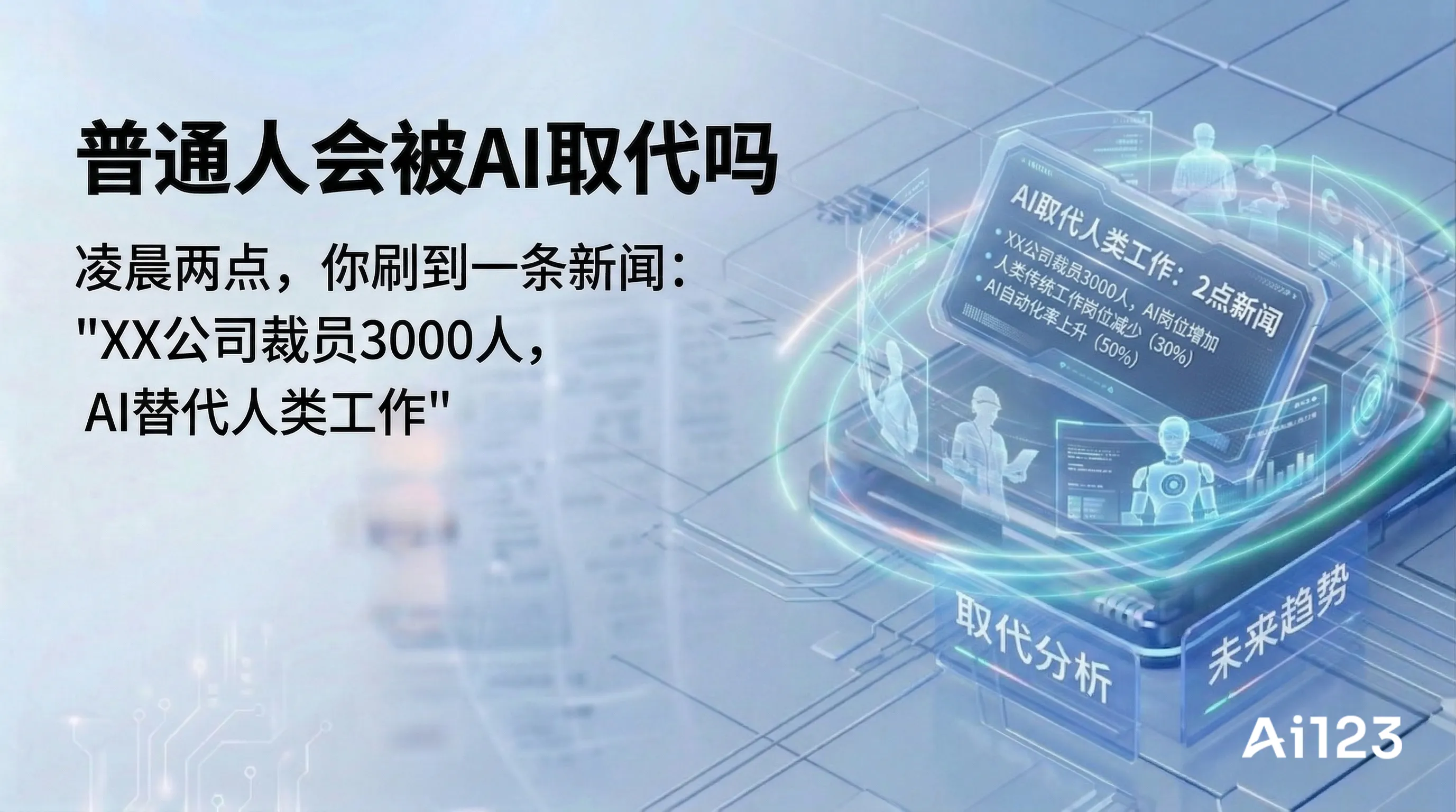
At 2 a.m., you're scrolling and see a news story: “XX Company cuts 3,000 jobs; AI replaces human work.”
At 2:05 a.m., you open a job-hunting app and find that every resume you've sent has sunk like a stone into the sea.
At 2:10 a.m., you lie in bed, tossing and turning: Will I be replaced by AI?
If you have this same anxiety, this article is written for you.
1. First, the Conclusion
AI will replace some people's jobs, but it won't replace everyone.
More precisely: Those who use AI will replace those who don't.
This conclusion may make you more anxious, or it may make you breathe a sigh of relief—the key is, are you the former or the latter?
2. Who Exactly Will AI Replace?
To be honest, the phrase “AI replaces humans” is a bit overblown. To be precise, AI will replace certain tasks within certain jobs.
1. The First to Be Affected: Repetitive Work
High-risk roles:
- Data entry clerk
- Basic customer service
- Basic copywriting
- Assembly line worker
- Simple translation
These jobs share common characteristics: clear rules, high repetition, and little need for creativity.
For example, in the past, when you called customer service, there was a real person on the other end. Now? It's likely an AI voice assistant. Answering a thousand calls and repeating “I forgot my password, what do I do?” ten thousand times would drive anyone crazy—AI is perfect for exactly this kind of work.
2. Temporarily Safe: Jobs That Require Human Interaction
Relatively safe roles:
- Therapist/Counselor
- Teacher
- Sales (high-end)
- Manager
- Nurse
- Entertainer/Performer
The core of these jobs is building trust and relationships with people, and AI can hardly replicate that emotional connection.
Of course, “relatively safe” doesn't mean completely safe. AI can assist in these jobs and improve efficiency, but fully replacing them is still hard.
3. Safest: Jobs That Require Creativity and Judgment
Hardest to replace:
- Artists/Designers
- Strategic planners
- Entrepreneurs
- Researchers
- Professional consultants
These jobs require judgment, creativity, and understanding of complex situations, which AI currently cannot achieve.
3. But! There's a Big “But”
Many people imagine AI as an enemy—either you replace it, or it replaces you.
Wrong!
AI is more like a tool such as the steam engine, the computer, and the internet. Their emergence did eliminate some jobs, but it also created many more.
History tells us:
- Typists disappeared, but Word enabled more people to write
- Ticket sellers decreased, but Didi created more jobs
- Physical stores were hit, but e-commerce made countless entrepreneurs successful
AI is the same. It will eliminate some positions, but it will create even more new ones.
The key is: Are you willing to learn new skills and seize new opportunities?
4. Survival Rules for the AI Era Workplace
Rule 1: Learn to “Ride” AI, Not “Fight” It
In the past, if you knew Office, people called you a “computer expert.” Now, if you know how to use AI, people call you an “efficiency guru.”
Make AI your tool, not your threat.
Just like the first people who learned to use computers back then—they weren't replaced by computers; they became more competitive than those who didn't know how to use them.
Rule 2: Cultivate Abilities That AI Can't Easily Replace
Abilities AI lacks:
- Innovation capability
- Interpersonal communication
- Judgment on complex problems
- Emotional perception
- Cross-disciplinary integration skills
These abilities take long-term cultivation, but it's never too late to start practicing deliberately from now on.
Rule 3: Become a Hybrid Talent with “AI + Professional Expertise”
Knowing only AI is not enough; knowing only your specialty is not enough either.
The most sought-after talent = AI skills + industry expertise
For example:
- AI + Healthcare = Medical AI Engineer
- AI + Law = LegalTech Expert
- AI + Education = Smart Education Designer
- AI + Design = AI Designer
Rule 4: Keep the Habit of Learning
This is the most important rule.
In the AI era, knowledge updates faster and faster. There is no longer any skill that “once learned, lasts a lifetime”, and “Live and learn” is no longer just a motivational saying—it's a real requirement.
5. Coping Strategies for Different Groups
👨💼 Newcomers to the Workforce (0-3 years)
Strategy: Make AI your “first employee”
- Let AI handle the chores for you, freeing up time to learn core skills
- Use AI to quickly learn industry knowledge
- Proactively try AI tools at work
👨💻 Workplace Veterans (5-10 years)
Strategy: Use AI to empower your experience
- Use AI to summarize and distill your experience into a methodology
- Use AI to handle repetitive tasks and focus on high-value work
- Consider becoming a trainer or consultant with “AI + experience”
👨🎓 Students
Strategy: Build an AI mindset from now on
- Use AI as a learning aid
- Consider AI's impact when choosing a major
- Cultivate interdisciplinary abilities
👴 People About to Retire or Change Careers
Strategy: Do the things AI can't help with
- AI is not good at things that require social savvy and emotional communication
- Service industry and people-oriented jobs are relatively stable
- Use AI to simplify daily life
6. Truths of the AI Era
Truth 1: Anxiety Is Useless; Action Matters
Instead of worrying about being replaced by AI, start learning to use AI now.
Today's AI learners are tomorrow's workplace winners.
Truth 2: There Is No “Iron Rice Bowl”; Only “Iron Ability”
No job is completely stable; only continuously evolving ability is the real “iron rice bowl.”
Truth 3: AI Eliminates “Tool People,” Not “People”
Those who only mechanically repeat their work are indeed in danger. But those who have thoughts, creativity, and human warmth will always be valuable.
Truth 4: The Ones Who Should Worry About AI Most Are Those Unwilling to Learn
It's not AI that makes you lose your job; it's stopping learning that makes you lose it.
7. A Little Story
I know an auntie, in her 50s, who works as a cashier at a supermarket.
A few years ago, she said: “It's over. In the future, everything will be self-checkout. I'm going to lose my job.”
So what happened? Did she lose her job?
No! She now works as a “self-checkout instructor” at the supermarket, specifically teaching elderly people how to use the self-checkout machines.
Her salary is even higher than before!
You see, AI eliminates some jobs, but it also creates new ones. The key is whether you're willing to change with the times.
Key Takeaways
- AI will replace some jobs, but not everyone
- Those who use AI will replace those who don't
- The first to be replaced: repetitive, rule-bound jobs
- The safest: jobs that require creativity and human interaction
- Survival rules: learn to ride AI, cultivate abilities AI can't replace, and keep learning
Finally, here's a parting thought:
In the AI era, the competition is not between humans and machines, but between “those who use AI” and “those who don't.”
Are you ready to become one of the former?
Related Recommendations

Zhipu Qingyan (ChatGLM) User Guide: From Beginner to Pro
AI Video Generation: A One-Person Production Team
What are the risks and challenges of AI development?
Why do AI talk nonsense with a serious look?

How can AI understand text, images, and sounds simultaneously?